How CPR After a Car Crash Saves Lives: A Chicago Perspective
CPR after a car crash starts with scene safety: don’t step into traffic or go near fire, fuel, downed wires, or an unstable vehicle. Call 911, give the exact location, and give CPR only when the scene is safe and the person is unresponsive and not breathing normally. That is the point at which the standard CPR steps call for CPR.
CPR after a car crash is rarely one person’s job. On a busy Chicago expressway, it works best as a relay, with each helper handing off to the next. This guide covers five roles: the first witness, the 911 caller, the hazard spotter, the CPR-trained responder, and the person who briefs EMS. At a small scene, one person may cover several of them.
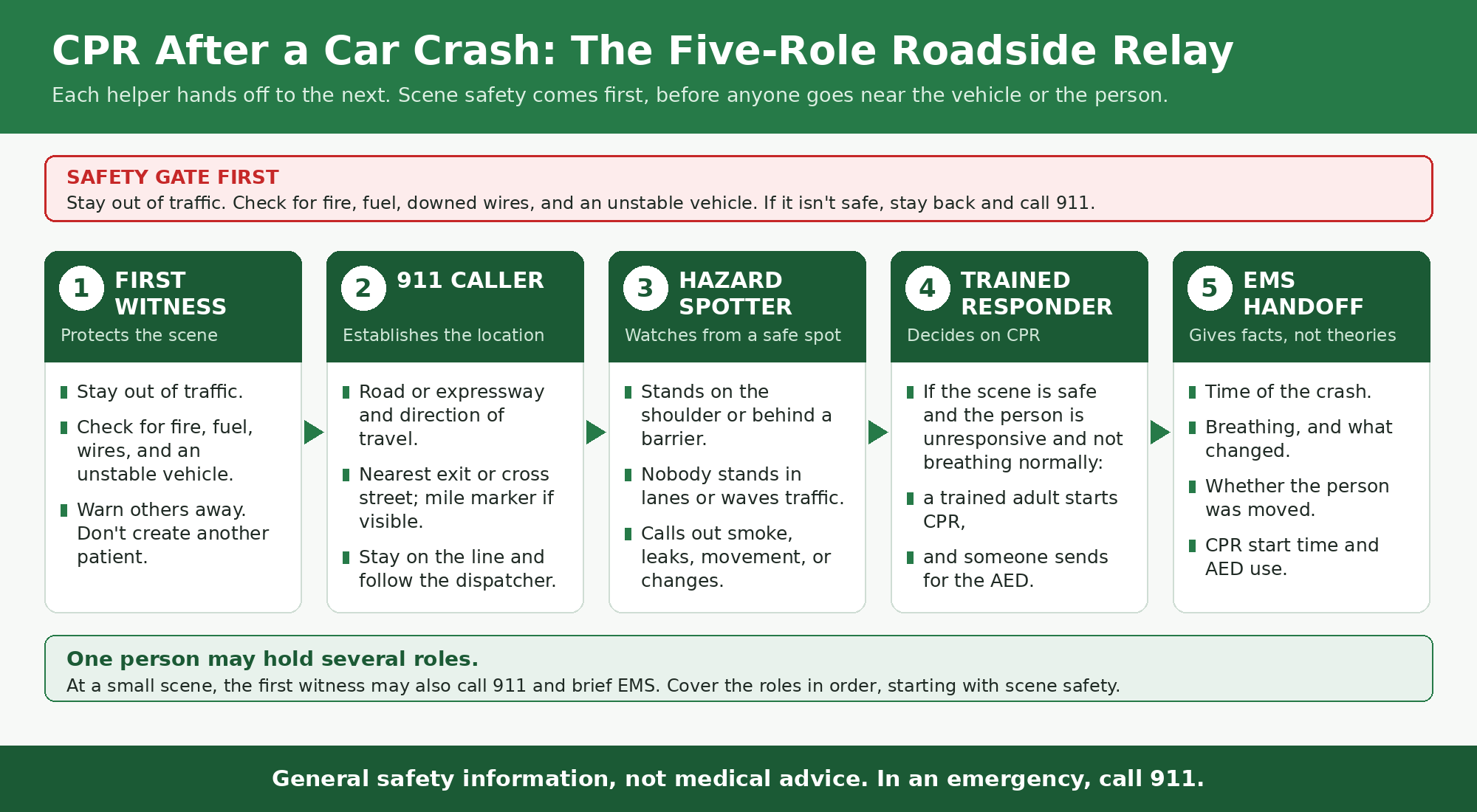
Relay Role 1: The First Witness Protects the Scene
Look for hazards before you go near anyone:
✓ Moving traffic and vehicles still in active lanes
✓ Rain, snow, ice, or low visibility
✓ Fire, smoke, or leaking fluids
✓ Downed wires, broken glass, or sharp metal
✓ A vehicle that could roll or shift
✓ Hostile behavior from anyone at the scene
✓ A narrow shoulder, a bridge, or the risk of a second collision
Every emergency response begins by checking the scene for safety before giving care.
Helping Does Not Require Entering Every Scene
Often the most useful thing you can do is call 911, give the location, warn other people away, follow the dispatcher’s instructions, and wait somewhere protected while reporting what changes. Don’t try to direct high-speed traffic.
Do not create another patient. A bystander who is hit, burned, shocked, or trapped can’t help anyone. The scene has to be safe before you do anything else.
Relay Role 2: The 911 Caller Establishes the Location
“I’m on the Dan Ryan” doesn’t tell responders enough. Give the dispatcher:
✓ The expressway or road name and your direction of travel
✓ The nearest exit or cross street, and the mile marker if you can see one
✓ Whether you’re on a bridge, ramp, or in a tunnel
✓ How many vehicles and how many injured people are involved
✓ Any fire, smoke, wires, or fuel
✓ Whether lanes are blocked
✓ Whether anyone isn’t responding
✓ Your callback number
Use Landmarks Without Guessing
Exit signs, major intersections, building addresses, transit stations, gas stations, overpasses, and roadside businesses all help. Check your phone’s location only when it’s safe and legal to do so. If you don’t know something, say so rather than guess.
Stay With the Dispatcher
Stay on the line. The dispatcher may confirm your location, ask whether anyone is breathing and responding, give you instructions, update the responding units, and tell you where to wait.
Relay Role 3: The Hazard Spotter Watches What the Responder Cannot
Once a trained person is helping the patient, a second bystander should watch the traffic, any smoke or fire, whether the vehicle is moving, new leaks, aggressive bystanders, the weather, arriving emergency vehicles, and whether the way out is still clear. The spotter calls out right away if anything changes.
The Spotter Is Not a Traffic Officer
Stay out of travel lanes, and don’t wave cars around the crash. Traffic control belongs to police and fire crews.
Relay Role 4: The Trained Responder Decides on CPR After a Car Crash
Keep the medical steps simple:
- Make sure the scene is safe enough to approach.
- Check whether the person responds and is breathing normally.
- Have a named person call 911 if no one has yet.
- Send someone for an AED if one is reasonably close.
- Begin CPR if the person is unresponsive and not breathing normally.
- Follow the dispatcher’s and the AED’s instructions.
- Keep going until responders take over or the scene becomes unsafe.
The standard CPR steps also include checking for life-threatening bleeding during that first assessment. Illinois Safety’s How to Perform CPR page reviews the compression technique. CPR needs the person on their back on a firm, flat surface; if that isn’t possible, follow the dispatcher’s instructions.
Trauma Does Not Automatically Rule Out CPR After a Car Crash
A crash victim may have serious injuries. If they’re unresponsive and not breathing normally, CPR may still be needed. Avoid moving them more than you have to, and follow your training and the dispatcher.
Do Not Remove a Person From a Vehicle Without a Safety Reason
Guidance on head, neck, and spinal injuries names vehicle collisions as a common cause. It advises not moving the person unless you need to give CPR or can’t control bleeding. It also says to keep infants and children in their car seats unless they need to be moved for CPR. Fire, traffic, or another hazard that is getting worse can change that decision. Follow the dispatcher’s lead.
Leave a Helmet On Unless CPR Is Needed
For motorcycle and bicycle crashes, the standard advice is not to remove a helmet unless CPR is needed. Airway access, breathing, hazards at the scene, and your training all affect that call.r training all affect that call.
When an AED May Be Useful After a Crash
An AED matters because the person may be in cardiac arrest, not because there was a collision. Whether you use one depends on whether the person is responding and breathing. Follow the device’s prompts. Wet clothing, metal surfaces, or injuries may require adjustments you learn in class. Don’t put off calling 911 to go looking for an AED far away. Standard CPR guidance calls for using an AED as soon as one is available once CPR has started.
Relay Role 5: The EMS Handoff Person Gives Facts, Not Theories
Tell responders:
✓ About when the crash happened
✓ Whether the person was responding at first, how they were breathing, and what changed
✓ Whether anyone moved the person
✓ Hazards you saw, and serious bleeding or injuries
✓ When CPR started and whether an AED was used, if you know
✓ How many people were involved, and what other witnesses reported
Stick to what you saw. Don’t say “he definitely had a heart attack.”
Five Actions Bystanders Should Avoid
- Entering moving traffic or smoking near leaking fluids
- Pulling someone from a vehicle without an immediate need
- Giving food, drink, or medication. Don’t give anything to eat or drink to someone who may be in shock.
- Crowding the patient or filming and posting the scene
- Leaving before responders arrive if they may need you as a witness
Why Chicago Conditions Change Roadside Response
Crashes are common on Illinois roads. The IDOT 2023 Crash Facts report counts 299,133 motor vehicle crashes in Illinois in 2023, or about 820 a day. Congested expressways, narrow shoulders, snow and ice, early winter darkness, elevated roadways, complicated ramps, downtown pedestrian traffic, bikes and transit sharing the road, and heavy holiday travel all make a crash scene harder to manage. Construction zones, tunnels, and bridges add to the risk.
BLS and First Aid Prepare People for Different Parts of a Crash Response
| Training | Roadside role |
|---|---|
| CPR/AED | Responding when someone is unresponsive and not breathing normally |
| First aid | Initial care for injury or sudden illness, within course scope |
| BLS | Team-based response for healthcare professionals whose roles require it |
| Trauma education | Specialized assessment and care beyond this article |
Some readers search for BLS trauma training, but BLS doesn’t replace paramedic or trauma certification. The BLS certification class is built for healthcare providers. For the general public, HeartSaver First Aid CPR AED is designed for people with little or no medical training. It covers CPR, AED use, and first aid, including severe bleeding and shock.
CPR and First-Aid Training for Chicago Drivers
Rideshare, taxi, and delivery drivers, fleet operators, parents, school transportation teams, security staff, roadside-assistance workers, and frequent travelers can be the first people at a crash. If you’re looking for a CPR course Chicago drivers can fit into a work week, Illinois Safety teaches at training centers across Chicagoland. If you’re comparing providers, our guide to finding the right CPR training center in Chicago can help. Traveling for the holidays? Read our CPR tips for travelers.
Frequently Asked Questions
Should you perform CPR after a car accident?
When the scene is safe and the person is unresponsive and not breathing normally, CPR may be needed. Call 911 first, or have someone else call.
Should you remove an injured person from a vehicle?
Usually not. Moving them unnecessarily can cause harm. Immediate danger, or the need to give CPR, can change that. Follow the dispatcher’s instructions.
Can an AED be used after a traffic collision?
Yes. Using an AED depends on whether the person may be in cardiac arrest, not on what caused them to collapse.
Is BLS the same as trauma training?
No. BLS covers foundational life-support skills. Trauma courses go further into injury assessment and treatment.
Be Ready to Help Without Entering an Unsafe Scene
Most of what helps at a crash scene happens around CPR: staying safe, giving a precise location, and handing EMS clear facts. Hands-on training makes those steps feel automatic when it counts.
If you’d like to be ready for the road, here’s how it works with Illinois Safety:
- Choose a class: HeartSaver First Aid CPR AED for the general public, or BLS if your job requires it.
- Sign up online for a date at one of Illinois Safety’s Chicagoland training centers.
- Practice CPR, AED use, and first aid hands-on with an instructor.
Learn to recognize cardiac arrest and support emergency responders without putting yourself in danger. Review Illinois Safety‘s CPR, AED, first-aid, and BLS classes across Chicagoland, call (630) 290-4280, or contact us to schedule.
This article is general safety information, not medical advice. In an emergency, call 911.

















































 Powered by